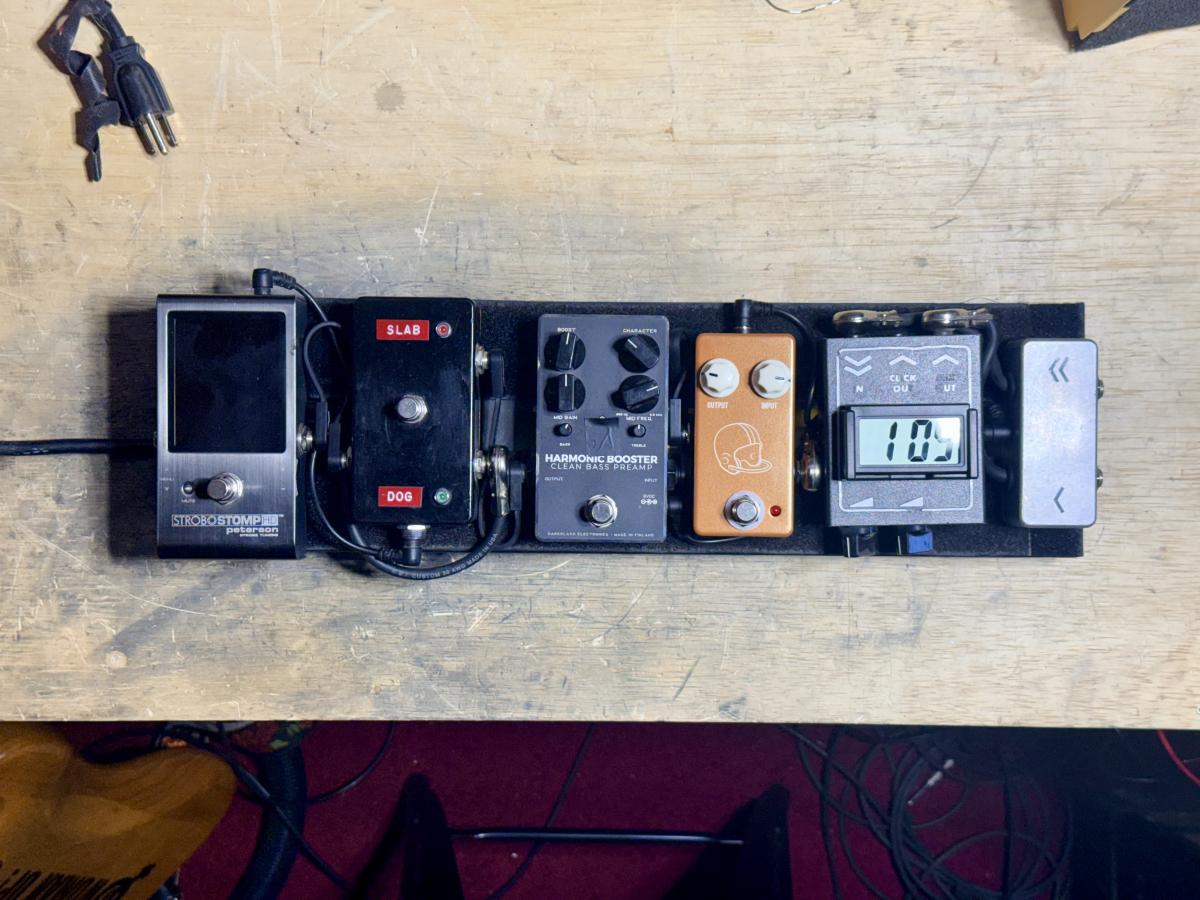
My pedalboard updated for Summer 2026. Signal chain includes from right to left: home made input box with 1 TRS jack for double bass, and 1 TS jack for electric bass, TRS double bass side goes to the K&K Rockabilly Plus pre-amp, TS electric bass side goes to a JHS Fumble, the Fumble goes to a Dark Glass Harmonic Booster, then both the K&K and Dark Glass pre-amps go into a home made A/B switch. The A/B switch goes into a Peterson StroboStomp HD, then out to my amp.
Pedalboard Summer 2026
I updated my pedalboard to make room for a JHS fumble. The happiest accident for my P-Bass.
A few years back, I bought my buddy Ivan a JHS NOTAKLÖN pedal kit for his birthday. He really liked putting it together, and loves the pedal. When JHS dropped the NOTADÜMBLË last year, I jumped on it immediately.
I like to experiment with a little overdrive on my P-Bass, and I got a pretty nice pick attack with the clean boost circuit on the NOTADÜMBLË—the circuit that Josh Scott mistakenly built into the pedal and ended up discontinuing a month later. I feel pretty lucky to have one, but it's way too big to fit on my pedalboard. I have been manually hooking it up for Bottom Dwellers gigs and rehearsals.
I was delighted to hear that JHS was releasing the circuit in a standalone, small format pedal—so delighted that I insta-bought one. I am equally delighted to report that it fits snugly on my pedalboard. Perfectly. Permanently.
So with this latest refresh, let's go through the board again…
As you may know, the primary intent of this board is to allow me to quickly and easily switch between double bass and electric bass (that’s why the tuner is at the end of the chain and not the beginning). The preamps give me a little better control over level balance and EQ before the basses hit my amp.
- Home made input box - I built this to reduce the wear and tear on my preamps. It also lets me put the pedals closer together because I don’t have to leave room between them for plugging in and unplugging. The top input takes a TRS cable from my double bass (thus the two left-pointing chevrons). One signal is from the bridge pickup, the other is from the fingerboard pickup. The bottom input (single left-pointing chevron) takes a standard TS cable from my P-Bass.
- K&K Rockabilly Plus - This is my double bass preamp. It has a set-it-and-forget-it three-band EQ on the inside, and level controls on the front to blend the two pickups. I stuck a digital clock on it because every pedal board should have a clock, so you know when to take your breaks!
- JHS Fumble - The newest addition. The P-Bass goes right into this from the input box. It’s not always on. I use it for songs that are a little more rockin’ or need more pick/tic-tac attack. It pushes the Dark Glass preamp right after it, enhancing the sub frequencies, adding compression, and slightly overdrive it, in addition to adding attack.
- Dark Glass Harmonic Booster - This handles the main tone shaping for the P-Bass. Double bass and P-Bass are two extremely different instruments that require two extremely different EQ settings. Lately I’ve been playing through a GK 800RB into a GK Neo 1x12. I EQ the 800RB for double bass primarily, and tweak the Dark Glass EQ to taste for the P-Bass.
- Home made channel switcher - This is just an A/B box I made to switch between double bass and P-Bass. No big deal. It has a red LED for electric bass (slab) and a green LED for double bass (dog), and takes 9 volts from the power supply.
- Peterson StroboStomp HD - My tuner of choice. I find strobe tuners easier to read, and this one is the easiest! The large, bright display is clearly visible in direct sunlight from nearly everywhere on the stage. It picks up double bass really well.
- Pedaltrain Nano+ - This is the board. The low profile and compact size allow me to tuck it next to my amp or set it on top when I want to be more discreet. It’s easy to pack away into my anvil gig case with the rest of my cables, mics, spare strings, etc.
- Truetone 1 Spot Pro - My power supply mounted underneath, out of sight, out of mind. It barely fits under the Nano+. It’s solidly mounted to the board with screws. Takes a licking and keeps on ticking.
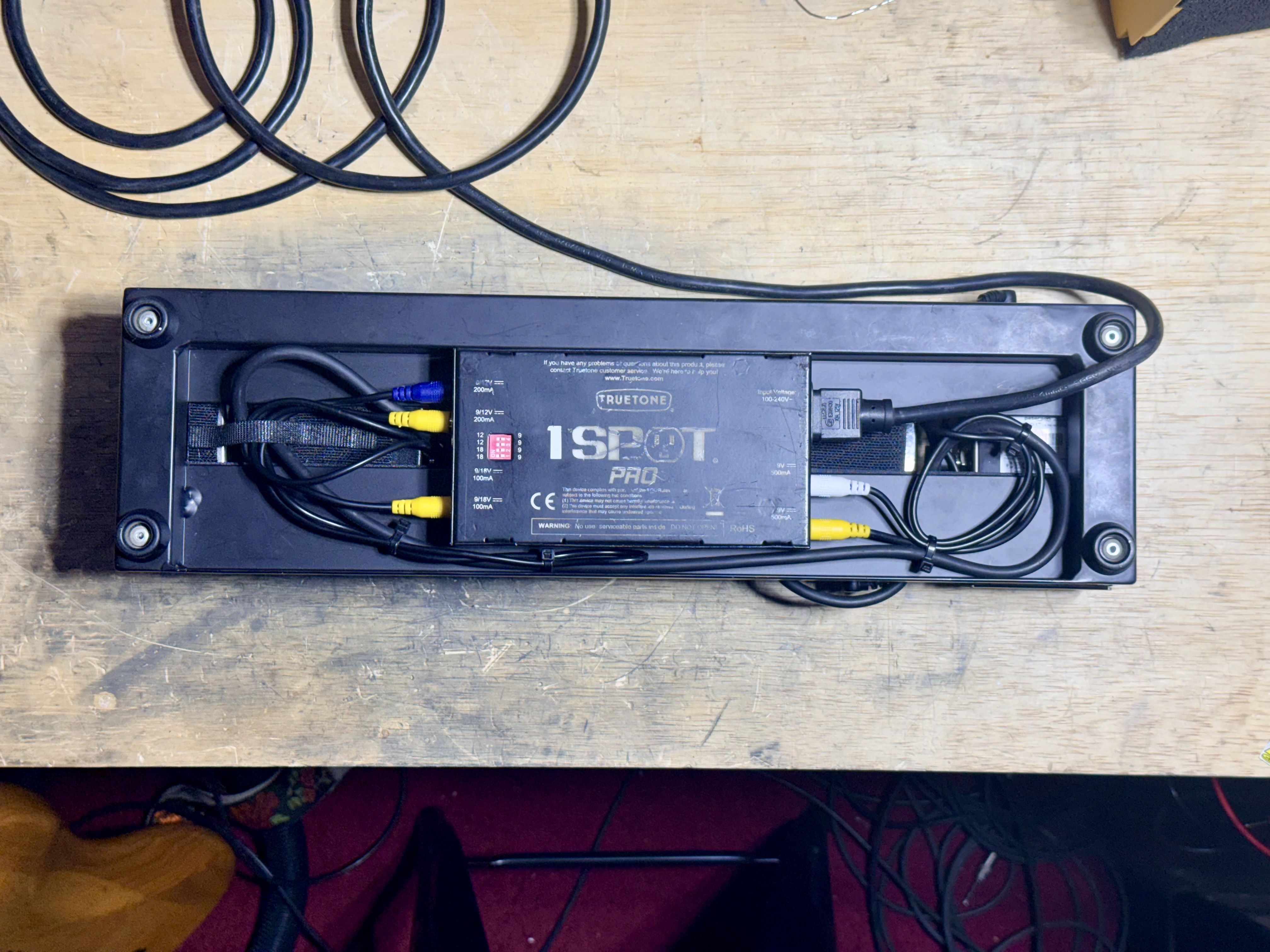
The underside of the Nano+ showing the power supply and cable management.
Cable management is pretty simple under the Nano+. I use velcro to keep some of the larger runs from flopping around, and small cable ties to snug everything together. It’s been very solid over the years, and as you can tell, it takes quite a beating. I play a lot of outdoor stages with swing dancers that kick up some serious dust.